12. Synthesis
The Advaita tradition hands its renunciates four sentences to carry. One is drawn from each of the four Vedas, and they are short enough to hold in the mouth for the rest of a life. Tat tvam asi, that art thou, from the Chandogya. Aham brahmasmi, I am Brahman, from the Brihadaranyaka. Prajnanam brahma, consciousness is Brahman, from the Aitareya. Ayam atma brahma, this Self is Brahman, from the Mandukya. The tradition calls them the mahavakyas, the great sentences, and its claim about them is immodest: the whole of the Upanishads, hundreds of pages laid down across centuries, comes to rest in these four, and any one of them, understood to its floor, carries the rest.
The word says what it intends. Maha is great and vakya is sentence, and in the older grammar of the ritual schools a great sentence is the one that completes the smaller ones, the sentence the others were each reaching toward. A synthesis, named a thousand years before we needed the word for it.
Keep one honesty in view from the start. The four were chosen. The Upanishads do not mark which of their lines are the great ones, so the tradition selected them, one per Veda, and drew a boundary around them the texts never drew. Even this synthesis is a line someone laid across a larger thing. Hold that. It comes back.
We build the opposite habit. We collect. A working engineer accumulates laws the way a garage accumulates tools: Hyrum’s law, that every observable behavior of a system will come to be depended on; Conway’s, that a design copies the communication structure that produced it; Postel’s, the fallacies of distributed computing, the DRY principle, the twelve factors. Each arrives on its own and earns its place, and the shelf only lengthens. We reach for the right one and put it back. We rarely stop to ask whether the shelf holds one thing seen from many sides, or many things that happen to share a room.
One of these essays, the eighth, proposed a test for exactly that question. In a coherent system one law runs at every scale, so you can read the whole from a single well-made part; where you cannot, there is no unifying law, only layers glued together. Eleven essays now sit on a shelf. Eleven principles, or so it has looked. The test is right there. It would be a small cowardice to write a twelfth and not turn the test on the other eleven.
The danger in turning it is the one the seventh essay named. To claim the eleven are secretly one is to lay a single shape over eleven things that may have been genuinely apart, which is the snake seen on the rope: a unity convincing precisely because I drew it, and not there. So use the cure that essay gave. Inline them back. Set each principle in front of you as its own thing again, strip it to the one move it actually makes, and read what is shared against what I am quietly supplying.
Strip them and look. The bug you cannot theorize is found by eliminating everything it is not. A wrong abstraction is repaired by taking it out and reading the substrate underneath, never by drawing a better one over the top. A recurring incident stops for good only when its cause is removed. The same motion runs through all three: take away what was added, and look at what was under it. The motion is not something I supplied. The essay on abstractions said it in as many words, that inlining is the same move as debugging by elimination, one layer up. The move is real, and it carries a name older than any of the tools. Neti neti. Not this, not this.
Under the move sits a claim, and the claim recurs even where the move does not. In one essay after another the boundary you work inside turns out to be a name someone drew, and the ground under it turns out to be one. The contract is what your callers rest on, not the signature you published. The service line is namadheya, a word laid over a graph that never honored it. Even the scales of a fractal system belong to how you look, while the thing keeps its single law. Read the eleven together and most of them lean on one load-bearing sentence: the division is drawn, the substance is one.
Run the test all the way, though, and two things fall out of it that a victory lap would have hidden.
The first is that the unity is partial, and saying so is the difference between a synthesis and a sales pitch. The subtraction move is narrower than the opening made it look. On-call knowledge is a kind of knowing that no elimination hands you. Event sourcing keeps the past on purpose, appending where subtraction would erase. And a good model is there to be kept, its edge watched while you go on using it. Several of the eleven sit at an angle to the move, and to melt them flush would draw the exact snake this essay is spending its length refusing. The recognition returns through the book without ruling every page.
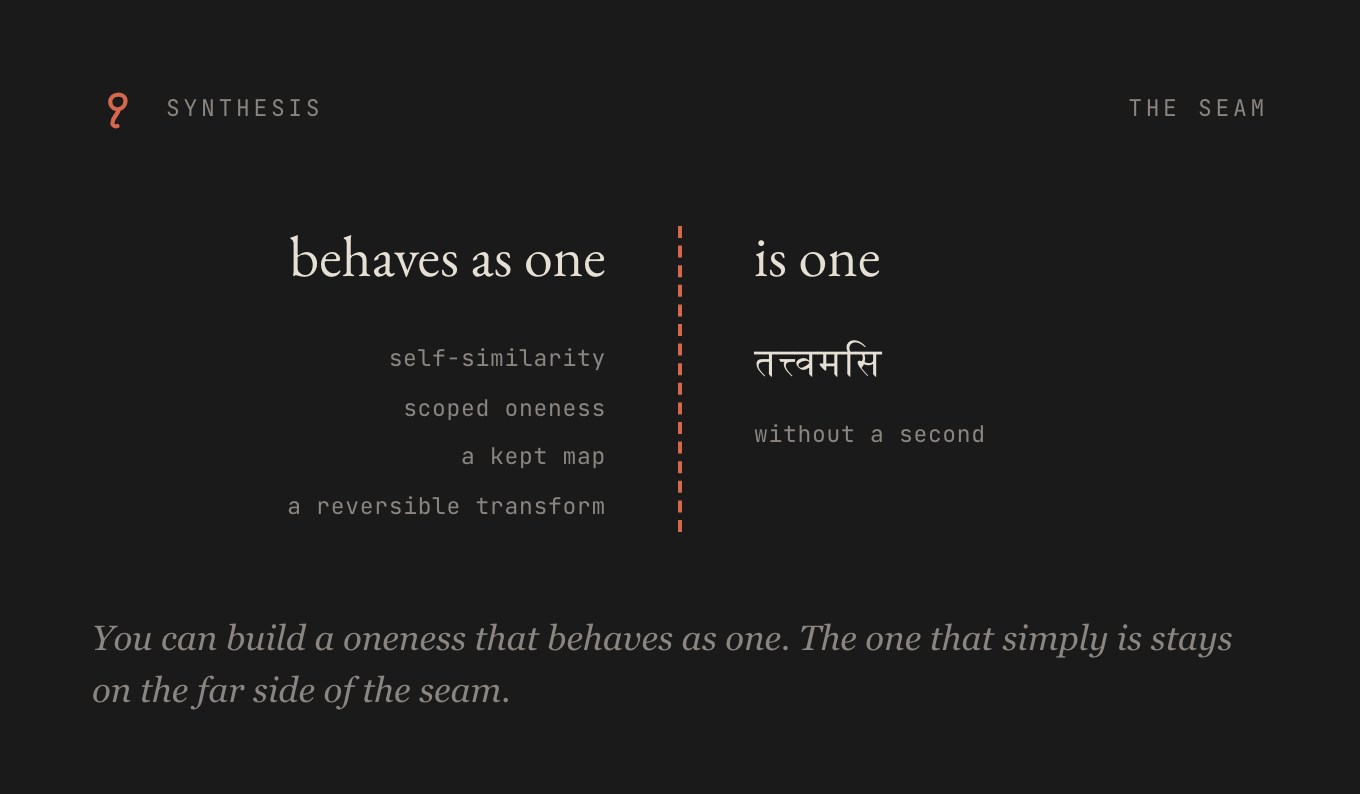
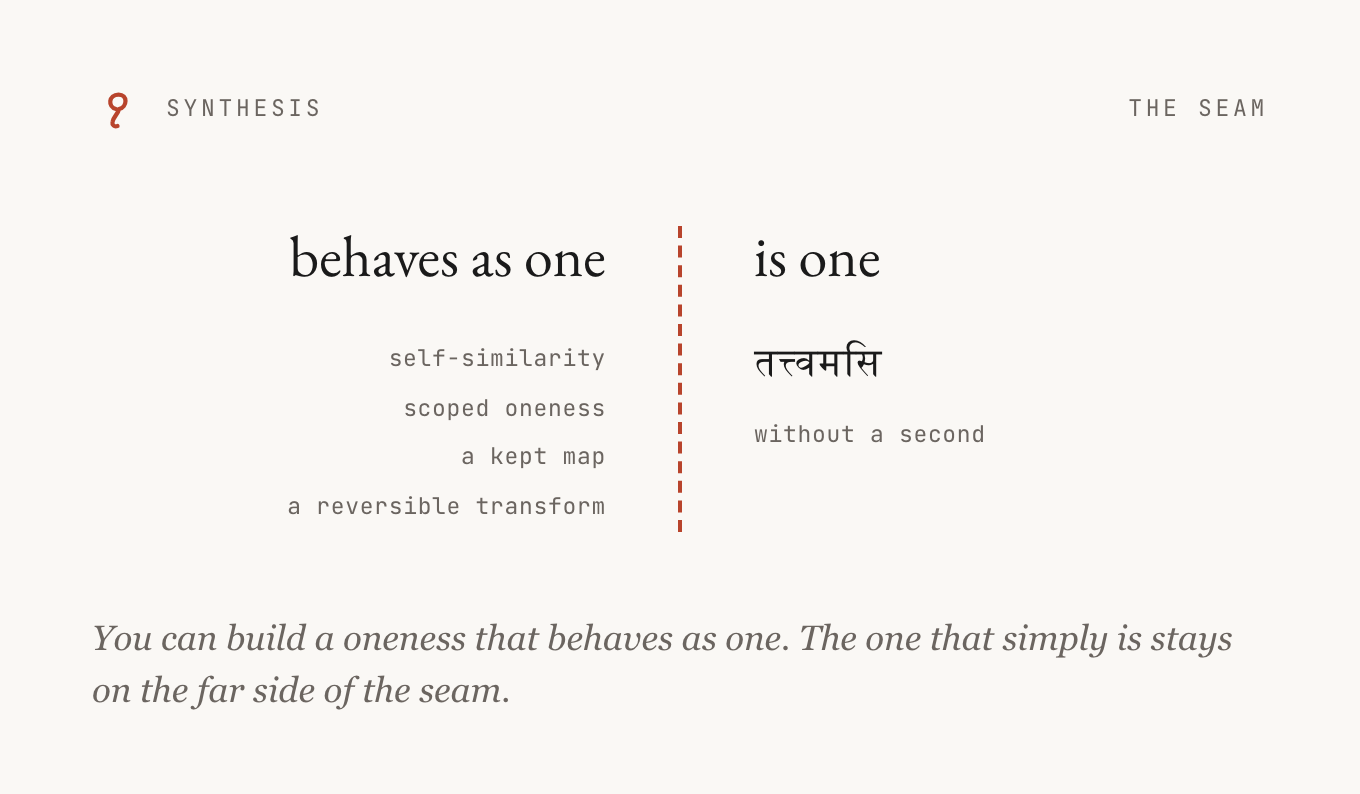
The second is the seam, and it is the one worth the whole essay. Where the essays do share that load-bearing sentence, that the ground is one, every one of them had to pull back from what the sentence plainly says. The mahavakyas do not pull back. Tat tvam asi is an identity. That art thou, not that resembles thou. The tradition means the many are one, without a second, whether or not anyone built them so. Software never reaches that, and the essays admitted as much, each at its own edge. A component mirrors the whole’s law and remains a component. Trace a distributed system and it is one only within the reach of a shared request; the cosmos is not a trace. You keep a model and work on it, and the ground stays on the far side of the measurement. Production is the last order that counts, and it is still not Brahman.
That is one seam, showing in place after place. Software builds self-similarity, a scoped oneness, a faithful map, a reversible transform. It even builds a kind of identity: content-addressing folds two blobs with the same bytes into a single object. But that is the identity of things already alike. What the mahavakyas claim is the other kind, the sameness of what looks nothing alike, the self that is the whole, and software never reaches it. The oneness you can engineer is a built thing, bounded, lasting exactly as long as you maintain it. What the Upanishad points at was never built and needs no maintaining. The gap is not a defect in the mappings. It is the floor they all stand on, and naming it is the difference between borrowing a structure and importing a cosmology this project set out to leave alone.
There were never twelve principles. One recognition keeps returning through them: the boundary is a name you drew, and the ground it hid appears only when you take the name away.
You can watch four of these stop being separate in a tool already open in your terminal.
Git is one design decision wearing several features. Bisect is neti neti with a script: mark the commits good or bad and let elimination hand you the one that broke, which is the method the first essay is built on. The tree is self-similarity you can run: a subtree lifted out is a tree in the identical sense the root is, named by a hash of its own contents, the part carrying the whole’s form. The object store is the karmic ledger at the level of the object: nothing is edited in place, a change writes a new object addressed by its content, and the old one is left exactly as it was. And all of it is a single graph. Every object is a node in one content-addressed structure, and a branch is a ref, a name you wrote that points at a commit. Move the name and not one object changes, because the name was never part of the substance. Namadheya, in a directory you can list.
Four principles, and beneath them one choice: the immutable, content-addressed object graph. They fall out of a single decision, which is what it means for a part to carry the law of the whole.
The restraint is the rest of the point. Git does not carry all eleven. There is no dharma in it and no samsara, and even the karma is partial: rebase and force-push exist to rewrite the very history the object store keeps, the same immutability exception the fifth essay drew around an append-only log. The well-made part shows you the whole’s law and stays a part. That was the eighth essay’s claim and, in the same breath, its limit, and a finale does not get to forget the limit because the pattern turned out pretty.
There is one thread left to pull, because it ran through every essay and never announced itself. The second person. You stare at a bug you did not write, you run the UPDATE that destroys the past, and later you open the trace and find the saturated pool three services away. That was not a stylistic habit. The engineer was never standing outside the system reading it off a diagram. You were always a region of the graph you were debugging, on call for a whole you are inside of. The book had been saying so in its grammar the whole time.
The project is called ekam, one, and that was the entire claim. Not twelve truths on a shelf. One recognition, walked into again and again through ordinary engineering problems, each of which turned out to open onto the same room.
And then the last honesty, which is the ninth essay turned back on this book. This framework is a model too. It measures two territories, a tradition and a craft, each far too large to hold, and it marks off the couplings it chose to see and stays quiet about the rest. It is accurate where it was careful. Past the edge it drew, it goes blind. Keep it the way you keep any good map, for the reach it gives you. The Upanishads are not a design manual, and your production system is not Brahman. What stands between them is a measurement, and this was it.
Further Reading
The four mahavakyas are traditionally drawn one from each Veda: tat tvam asi from the Chandogya Upanishad (6.8.7), aham brahmasmi from the Brihadaranyaka (1.4.10), prajnanam brahma from the Aitareya (3.3), and ayam atma brahma from the Mandukya (2). Robert Ernest Hume’s 1921 translation in The Thirteen Principal Upanishads (Oxford, public domain) carries all four. That these particular sentences are “the great ones,” selected one per Veda and taught as four mantras at initiation into sannyasa, is a codification of the later Advaita tradition rather than a claim the Upanishads make about themselves; the honest blend is worth knowing as a blend. On the older sense of a “great sentence” as the one that completes the smaller ones, see the Mimamsa treatment of the mahavakya, which predates the Vedantic use.
The Git object model that carries four of these principles at once is documented in the Pro Git book (Chacon and Straub, chapter 10, “Git Internals”). The eleven essays this one reads across each stand on their own and carry their own sources.