8. Atman = Brahman
You clone a repository you have never seen and open one file somewhere in the middle. A single handler, a hundred lines. If the system is any good, that one file teaches you the rest of it. Errors are raised here the way they are raised everywhere. The names line up with names in modules you have not read yet. You can guess the shape of the layer above this one and be mostly right, and an hour later you are productive in a codebase you had never opened, because the part carried the plan of the whole.
Other systems do not read this way. You learn one module and you have learned exactly one module. The layer beneath it keeps different rules, invented by a different person on a different afternoon, and knowing this one tells you nothing about the next. You cannot hold the system in your head, because there is no single system to hold, only a stack of unrelated ones sharing a deploy.
The Upanishads have a name for the first kind of structure, and it is the most radical thing they say. Atman is Brahman. The self in here is identical with the reality out there, the same thing entire, not a fragment of it or a spark thrown off it. The microcosm is the macrocosm. What you are is what everything is, seen from one location.
The Isa Upanishad states it as a way of seeing. It is one of the shortest of the principal Upanishads, the fortieth and last chapter of the White Yajur Veda, and its central verses turn on a single reciprocal move. One who sees all beings in the Self, and the Self in all beings, it says, shrinks away from nothing thereafter. And for the one to whom all beings have become the Self, “what delusion, what sorrow is there of him who perceives the unity.” The whole lives in each being, each being lives in the whole, and the two directions close into one.
The text opens, before its first verse, with a peace invocation that names the property exactly. Rendered plainly: that is whole, this is whole; from the whole the whole arises; take the whole from the whole, and the whole remains. It reads like a riddle until you notice it is describing a specific kind of quantity, one that is not diminished when a copy of itself is removed. Subtract the whole from the whole and nothing is lost. That is the arithmetic of the infinite, and no finite codebase quite reaches it. What a codebase can hold is the same move one scale down, likeness of kind rather than equal measure, and the plainest place it shows up is version control.
We do not usually build this way on purpose, and we rarely name it when we do. We keep coding standards for the function and architecture reviews for the system, as though a method and a service were different kinds of thing that happen to share a language. The blind spot in that division is the possibility the identity points at: that in a system with any integrity, the function and the service and the whole obey a single law, and the split into scales belongs to how we look, while the thing keeps its one law.
Git is built on this precisely. A commit points to a tree. A tree is a list of blobs and other trees. A subtree, lifted out and looked at on its own, is a tree in the identical sense the root is a tree: the same object type, named the same way, by a hash of its contents. There is no privileged whole-tree made of some different substance than its parts. And because git never mutates an object, lifting a subtree out costs the original nothing: the tree it came from is untouched, the same hash holding the same entry. You take the whole from the whole, and the whole remains. That is a finite echo of the peace invocation, running in an object database. You can watch it with git cat-file: descend into a tree and it hands you back another tree, until you reach the blobs at the leaves.
That is self-similarity of structure, and it is the shallow version. The deep version is when the part runs the whole’s law. Kubernetes is the clearest working example. Its whole job is to hold a cluster at a state you declared, and it does that job with one move repeated at every scale, the reconcile loop: look at the desired state, look at the actual state, take a step to close the gap, then ask to be run again. A ReplicaSet controller runs this loop to hold a set of Pods at the count you declared. A Deployment controller runs it one level up, rolling those ReplicaSets forward when the spec changes. On each node the kubelet runs the same shape, holding that node’s Pods to their specs, and an operator you write for a resource of your own is one more instance of it. That loop is the law of the controllers. It is not the law of the whole cluster: the scheduler and the admission webhooks keep their own. Within the regime the controllers govern, they are the loop all the way down, the single-node kubelet and the fleet-wide controller running the same shape at their own scale.
This is what it means for a component to mirror the whole architecture: its behavior is the system’s behavior, instantiated once more at its own scale. Here the mapping reaches its honest edge, the point past which the Upanishad goes and code cannot. The Isa claims identity: all beings have become the Self, the seer perceives the unity, one thing wearing the appearance of many. A controller is not the cluster; a subtree is not the repository. What software gives you is self-similarity, the same law carried faithfully across scales. It is a strong and useful thing, and it leaves the boundary between the part and the whole standing. The part carries the whole’s law. It is not the whole. The stronger claim, that the separateness is itself the illusion, waits for its own essay, and it asks more than any running system can show.
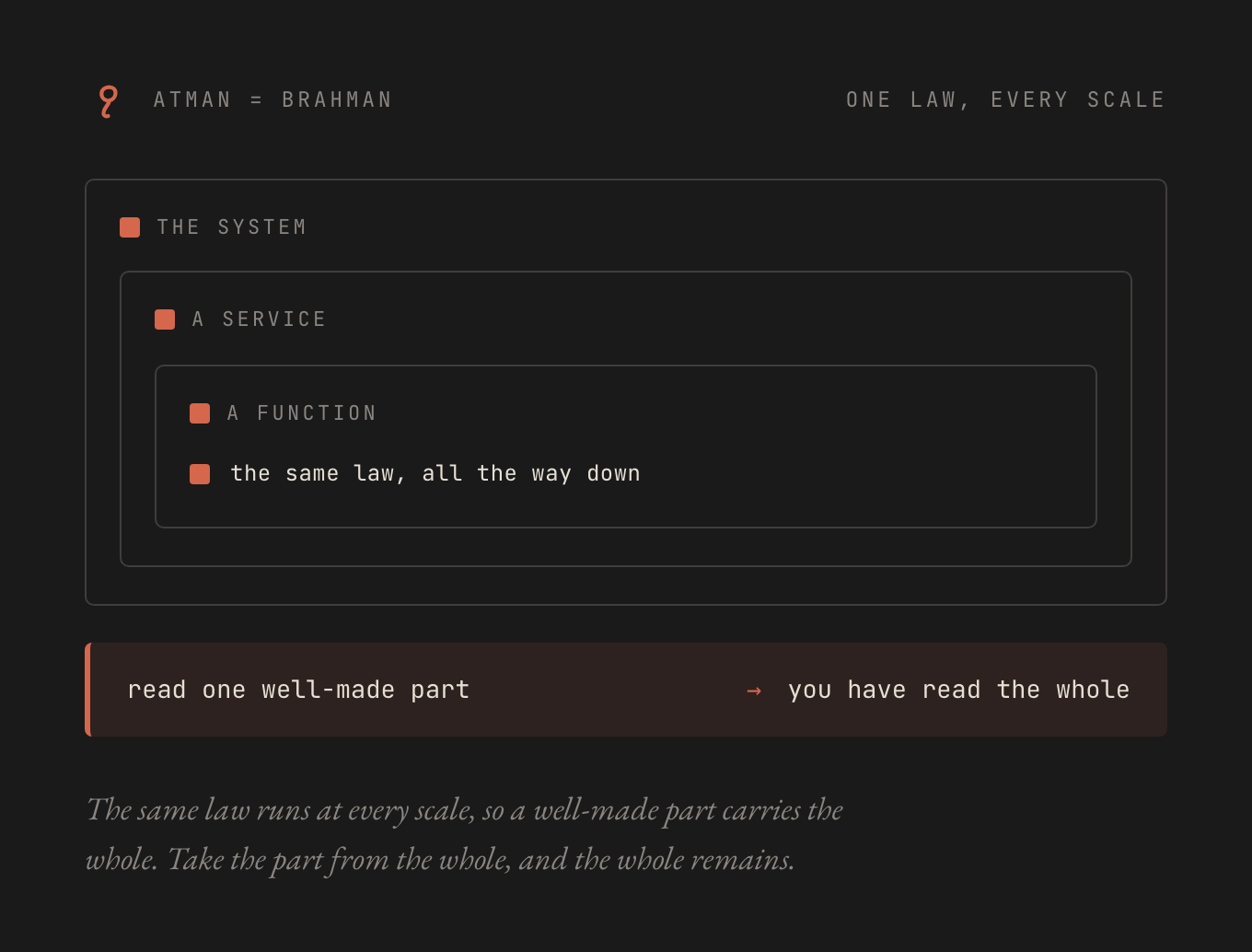
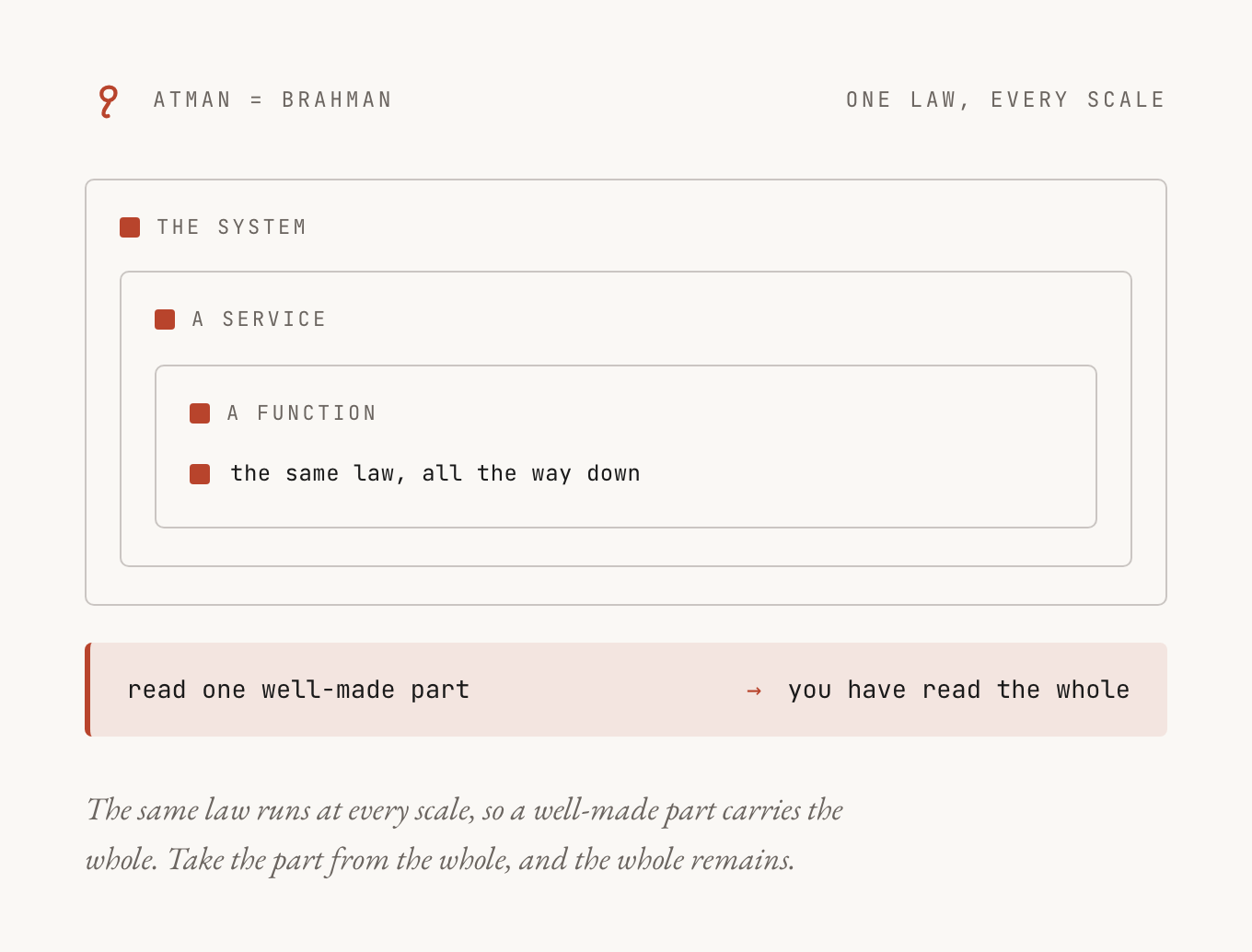
In a coherent system, one law runs at every scale, so you can read the whole architecture from a single well-made part. Where you cannot, there is no unifying law, only layers glued together.
The value of this is practical. Self-similarity is a test you can run on a Monday. Read one well-made part of an unfamiliar system and you have read the plan of the whole, which is why a coherent codebase is learnable from any honest slice of it. This is closer to on-call knowledge than to architecture-diagram knowledge. You do not study the map. You put your hands on one real part and let it teach you the law it carries. The test cuts both ways, and that is the useful half. When you cannot learn the system from a part, when every layer needs a fresh mental model and knowing one tells you nothing about the next, the failure is not in your understanding; it is a reading of the system itself. It says there is no unifying law here, that what looks like a system is layers assembled by accretion, and it says so early, while the accretion is still cheap to reverse.
The limits matter here more than usual, because a rule this satisfying tempts you to impose one law where the system has none.
The sharpest limit is that scale sometimes changes the law, and often should. The reconcile loop survives the jump from Pod to fleet because reconciliation is scale-free. Most things are not. A function call and a network call look alike in the source and are nothing alike underneath. One either runs or does not; the other can be slow, partial, duplicated, or lost without a word. A generation of distributed systems relearned this as the fallacies of distributed computing, the quiet assumptions that the network is reliable and latency is zero and the topology never moves, each of them false and each of them paid for in incidents. The in-process law is not the distributed law. A design that treats a remote call as just another method because they share a syntax is not being elegantly self-similar; it is being wrong at the most dangerous seam in the system. Self-similarity is the mark of coherence within a regime. The in-process, the distributed, and the human organization that ships them are three different regimes, and each keeps its own laws.
Two smaller cautions come from the same care. Repetition is not self-similarity. A thousand services stamped from one template, a file of copy-pasted handlers, a directory of near-identical CRUD: these repeat a surface without sharing a law, and duplication is worth preferring over a wrong abstraction, which is a smaller and more careful claim than calling repetition a virtue. Self-similarity is one organizing law that recurs. A photocopied shape has nothing underneath it but the copy. And the mirror is something you find. You do not make a system coherent by ordering every module to imitate the whole, handing each its own little framework and calling the nesting fractal. That yields cargo where you wanted coherence. The self-similarity in git and in Kubernetes was never painted on. It fell out of choosing one honest law and refusing to carve exceptions into it. A part comes to carry the whole’s law because the whole has one.
Go back to the file you opened in the unfamiliar repository. Whether that one part taught you the whole was never a fact about how clever you are. It was a fact about the system, a report on whether it ran one law or many. The Isa’s word for the oneness the seer perceives is ekatvam, one-ness. It is a tall word for a low and testable thing. Open a part and see whether it carries the whole. If it does, you can trust the rest of the system without reading it. If it does not, you have learned the architecture’s real problem, and you learned it from a hundred lines.
Further Reading
The Isa Upanishad, also called the Isavasya, is available in several public-domain translations. Robert Ernest Hume’s, in The Thirteen Principal Upanishads (Oxford, 1921), is the source of the lines quoted here; F. Max Müller’s, in The Upanishads, Part I (Sacred Books of the East, 1879), renders the same verses a little differently and is worth reading beside it. Shankara’s commentary on the Isa (Advaita Ashrama, translated by Swami Gambhirananda) carries the non-dual reading in full. On the software side, the Kubernetes documentation on the controller pattern and reconciliation is the primary source for the reconcile loop, and the Pro Git book (Chacon and Straub, chapter 10, “Git Internals”) walks the object model the essay leans on. For self-similarity as the signature of coherent design rather than an ornament, Christopher Alexander’s The Nature of Order (2002 onward) is the deep treatment, and the whole pattern-language lineage in software descends from his earlier A Pattern Language (1977).